What Are the Variations of Teen Patti? A Complete Masterclass Tutorial
Teen Patti, often dubbed “Indian Poker,” is the undisputed king of traditional card
games in South
Asia. Originating from the British game of Three-Card Brag, it has evolved into a cultural phenomenon.
Today, with the rise of digital gaming platforms like TeenPattiPro, millions of
players
enjoy this thrilling game of strategy, psychology, and luck right from their smartphones.
While the
classic version of Teen Patti is incredibly engaging, the real excitement lies in its
variations. Playing the same standard rules can become predictable. To keep the
adrenaline pumping, players have invented dozens of variations that flip the rules, introduce wild
cards, and alter hand rankings.
If you want to transition from a casual player to a versatile pro,
you need to master these variations. This comprehensive tutorial will guide you through the most
popular, thrilling, and strategic Teen Patti variations you can play today.
1.
Refreshing the Basics: The Standard Teen Patti Rule Base
Before diving into the variations, we must establish a solid foundation. In every
variation, the core
mechanics of standard Teen Patti usually still apply.
The Hand
Rankings (Highest to
Lowest)
- Trail / Trio / Set: Three cards of the same rank (e.g.,
$A\spadesuit-A\heartsuit-A\diamondsuit$ is the highest).
- Pure Sequence / Straight Flush: Three consecutive cards of the same suit (e.g.,
$A\spadesuit-K\spadesuit-Q\spadesuit$).
- Sequence / Straight: Three consecutive cards of different suits (e.g.,
$5\spadesuit-6\heartsuit-7\clubsuit$).
- Color / Flush: Three cards of the same suit, not in sequence (e.g.,
$2\diamondsuit-5\diamondsuit-J\diamondsuit$).
- Pair: Two cards of the same rank (e.g., $9\spadesuit-9\heartsuit-2\clubsuit$).
- High Card: The highest card in the hand when no other combination is formed.
Core Gameplay
Mechanics
- Boot Amount: The minimum stake placed into the pot before cards are dealt.
- Seen vs. Blind: “Blind” players bet without looking at their cards (paying the
current stake). “Seen” players look at their cards and must bet double the blind player’s amount.
- Sideshow: A player can request a comparison with the previous player’s hand if
both
are “Seen.”
Now that you remember the basics, let’s explore the exciting world of Teen Patti
variations!
2.
Joker / Wild Card
Variations (The Crowd Favorites)
Joker variations are highly popular because they introduce unpredictability. In these
games, specific
cards act as “Wild Cards” (Jokers) that can substitute for any card to form the best possible
mathematical combination.
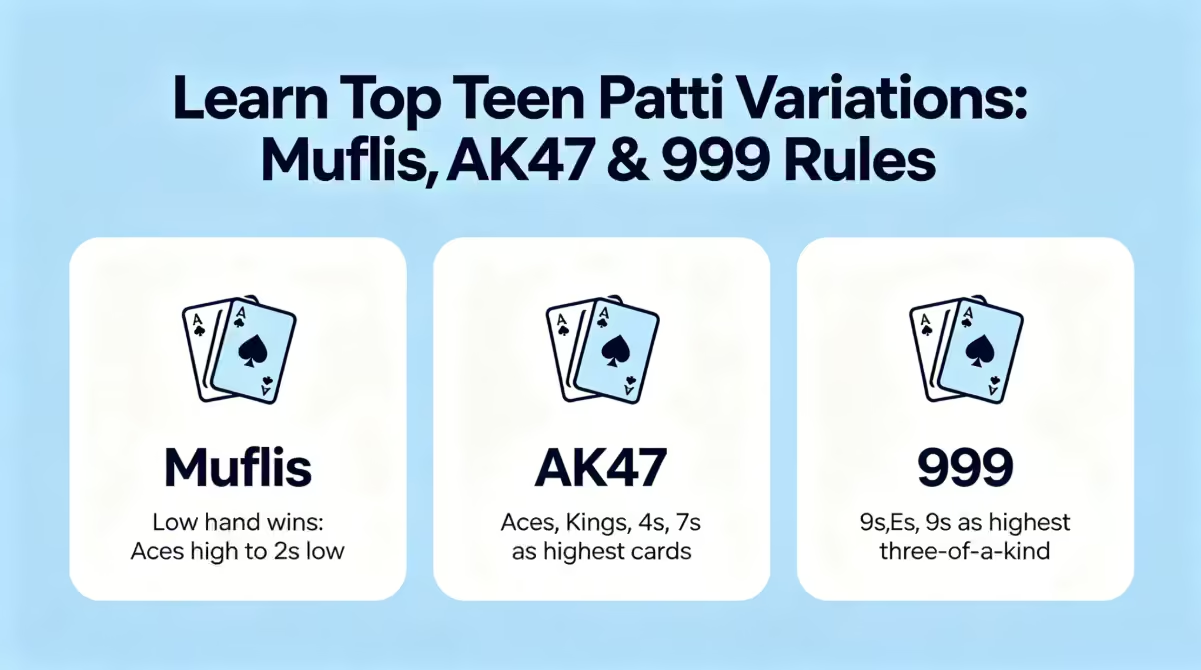
Variation A: Muflis
(Lowball)
In Muflis, the standard hand rankings are completely reversed. The
worst possible hand
in classic Teen Patti becomes the ultimate winning hand here.
- How to Play: The game is dealt exactly like standard Teen Patti. Players place
bets
and can play Seen or Blind.
- The Twist: During the showdown, the player with the lowest hand wins.
For
example, a High Card of 7 beats a Pair of Aces. A Trail of Aces ($A-A-A$) is the absolute worst
hand.
- Pro Tutorial Tip: If you are dealt a terrible hand like $2-3-5$ of different
suits,
do not fold! In Muflis, this is your goldmine. Play aggressively, but watch out for opponents who
might have an even lower combination like $2-3-4$.
Variation B: AK47
Named after the famous rifle, AK47 turns specific cards into universal
wild cards.
- How to Play: The dealer distributes three cards to each player.
- The Twist: All Aces (A), Kings (K),
Fours
(4), and Sevens (7) of any suit act as Jokers. If you hold a 4, you can
declare it as an Ace, a King, or any card needed to complete a Trail or Pure Sequence.
- Pro Tutorial Tip: Because four different ranks are wild cards, almost every
player
at the table will have a powerful hand (Pairs, Sequences, or Trails). Do not bet heavily on a simple
Flush; in AK47, you usually need at least a high Sequence or a Trail to win safely.
Variation C: King
Little
This variation dynamically changes based on the cards dealt into your hand.
- How to Play: Three cards are dealt to each player.
- The Twist: All Kings (K) are automatically Jokers. Additionally,
the lowest-ranking card in your specific hand also becomes a Joker.
- Example: If your hand is $K-8-5$, the King is a Joker, and the 5 (the lowest
card)
is also a Joker. You now have two Jokers, meaning you can turn this hand into a Trail of 8s
($8-8-8$).
- Pro Tutorial Tip: If you have two cards of the same rank and a lower card (e.g.,
$9-9-3$), the 3 becomes a Joker, transforming your hand into a Trail of 9s.
Variation D:
Joker (Classic, On the Table, & Hand Joker)
There are three common ways to play traditional Joker variations:
- Auction: Players can bid pool chips to buy a face-up Joker card placed on the
table
to improve their hands.
- Closeness / Closest to 55: Players try to get cards whose total mathematical
value
is closest to 55.
- Open Joker: The dealer places one card face-up on the table after dealing. All
cards of that rank across the table become Jokers.
3.
Structural & Dealing Variations (Altering the Game Flow)
These variations do not just change card values; they change how cards are distributed,
held, or
discarded, requiring a completely different tactical mindset.
Variation E:
Best-of-Four
This variation gives players more options, reducing the element of pure luck.
- How to Play: The dealer distributes four cards to each player
instead of three.
- The Twist: Players must evaluate their four cards, select the best three-card
combination to play, and discard the fourth card before the betting rounds begin.
- Pro Tutorial Tip: This variation heavily rewards mathematical calculation. Look
for
overlapping potential. If you hold $7\spadesuit-8\spadesuit-9\spadesuit-9\heartsuit$, you can choose
between a Pure Sequence ($7-8-9$ Flush) or a high Pair of 9s. Always opt for the sequence ranking.
Variation F: 999
In 999, the core objective shifts from traditional poker rankings to a
numerical
target.
- How to Play: Three cards are dealt. The goal is to get a total hand value closest
to the number 999.
- Card Values: * Face cards (K, Q, J) and 10 count as 0.
- Ace counts as 1.
- Number cards (2-9) retain their face value.
- The Twist: You can arrange your three cards in any order to form the highest
possible three-digit number.
- Example: If you hold a 9, a 3, and a King (0), your best arrangement is
930. If you hold an Ace (1), a 7, and a 9, your best arrangement is
971.
- Pro Tutorial Tip: The perfect hand is $9-9-9$. If you have face cards, place them
at the end (the units place) so they don’t drag down your hundreds or tens place values.
Variation G:
Draw (Discard and
Replace)
This brings a classic Five-Card Draw Poker mechanic into the world of Teen Patti.
- How to Play: Each player receives three cards. A round of betting occurs.
- The Twist: Players can choose to discard one or more cards from their hand and
“draw” new ones from the deck to improve their chances. To draw a card, players usually must
contribute a pre-determined fee into the pot.
- Pro Tutorial Tip: Only draw cards if you are one card away from a high-value
hand,
such as a Pure Sequence or a Color. Do not waste chips drawing cards if your initial hand is
completely disconnected.
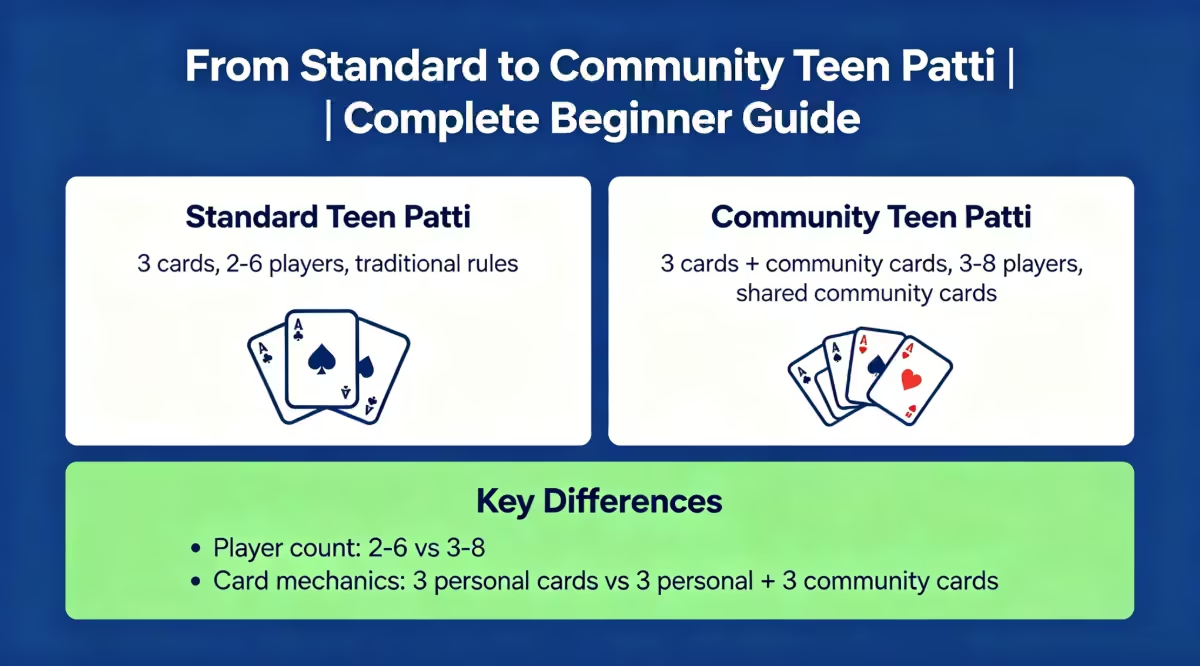
If you love Texas Hold’em, these Teen Patti variations will bridge the gap perfectly.
They introduce
shared cards laid out in the center of the table.
[Player’s Hand] [Community Cards]
(2 Cards) + (Open Table)
│ │
└───► Best
3-Card
Combination ◄───┘
Variation H: Lallan
Kallan
This is a color-coded wild card game utilizing community mechanics.
- How to Play: Three cards are dealt to each player, and one card is placed face-up
in the center of the table.
- The Twist: The central card’s rank is not the wild card. Instead, the card of the
same color but different suit (Lallan/Kallan) becomes the universal Joker. For
example, if the center card is the $7\diamondsuit$ (Red), then the $7\heartsuit$ (the other Red
suit)
becomes the Joker for all players.
- 3-Card Community: Players are dealt 2 private cards, and 1 community card is
dealt
face-up on the table. Players use these 3 cards to make their final hand.
- 5-Card Community: Players receive 2 private cards, and 3 community cards are
dealt
face-up. Players must choose any 3 cards out of the available 5 to form their ultimate Teen Patti
hand.
- Pro Tutorial Tip: Pay close attention to what your opponents might be building.
If
the community cards contain a $10\spadesuit$ and a $J\spadesuit$, expect someone at the table to be
holding a Queen or an Ace to complete a high sequence.
5. Summary Matrix:
Quick Reference Guide for Players
To help you choose the right variation for your next session on
TeenPattiPro, here is
a quick-glance strategy matrix:
| Variation Name |
Skill Level |
Game Pace |
Key Winning Strategy |
| Standard |
Beginner |
Moderate |
Master the psychological art of bluffing and pot control. |
| Muflis |
Intermediate |
Fast |
Play low-value cards aggressively; fold traditional high pairs. |
| AK47 |
Intermediate |
Very Fast |
Expect very high hands; do not play weak pairs or low flushes. |
| Best-of-Four |
Advanced |
Tactical |
Calculate probabilities before discarding your 4th card. |
| 999 |
Beginner |
Mathematical |
Arrange your cards to secure the highest hundreds-place digit. |
| Community |
Advanced |
Strategic |
Read table textures and calculate potential opponent combinations.
|
6. Pro
Tips for Transitioning Between Variations on TeenPattiPro
Navigating multiple Teen Patti variations requires more than just knowing the rules; it
requires
shifting your psychological framework. Keep these expert strategies in mind:
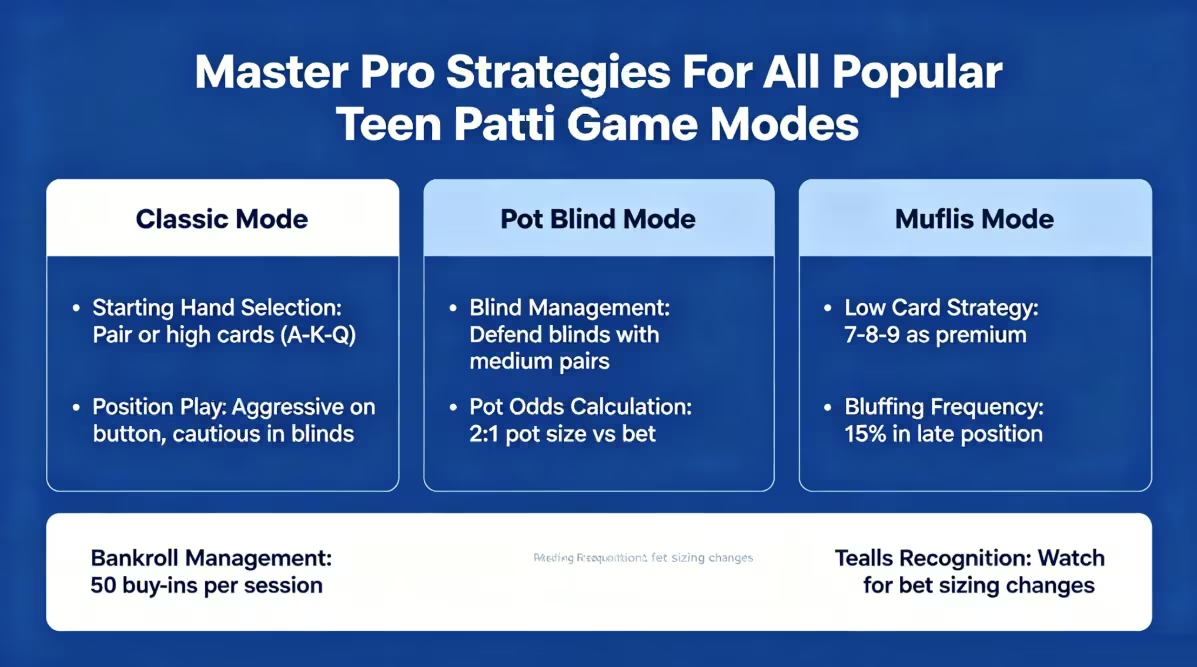
- Adjust Your Hand Thresholds: In high-wild-card variations like AK47 or
King Little, a basic Pair or Flush is mathematically weak. Raise your standards for what
constitutes a “playable hand.”
- Observe Your Opponents’ Adaptability: Many casual players forget which variation
is
being played after a few betting rounds. Watch for players betting aggressively on high cards during
a
Muflis game—they might be playing on autopilot, allowing you to exploit their mistakes.
- Manage Your Bankroll Strategically: High-paced variations result in massive pots
accumulating very quickly. Ensure your table stakes align with your budget, especially when playing
variations that allow drawing or buying extra cards.
Conclusion:
Elevate Your Game
Today
Teen Patti is far more than a single card game; it is an expansive universe of diverse
formats,
mathematical challenges, and strategic depths. By mastering variations like Muflis,
AK47, Best-of-Four, and 999, you will transform
your
gaming sessions from predictable routines into thrilling, dynamic showdowns.
Are you ready to test
your newly acquired knowledge? Head over to TeenPattiPro.com.in, explore our premium
guides, download the latest secure gaming applications, and start dominant runs at the tables today!