


If you have ever walked into an Indian household during Diwali, or logged into a mobile gaming app in South Asia, you have likely witnessed the high-stakes excitement of Teen Patti. Often referred to as “Indian Poker” or “Flush,” Teen Patti is deeply woven into the cultural and social fabric of India. While traditionally played with physical cards among friends and family, the digital revolution has transformed this traditional pastime into a massive global phenomenon.
At the forefront of this digital revolution is teen patti by octro indian poker
card
game. Developed by Octro, this specific adaptation has become one of the most downloaded
and
widely played card games in the world. It successfully captures the suspense, psychological warfare,
and
thrill of the physical game and packages it into a seamless mobile experience.
Whether you are
looking to download the game via platforms like TeenPattiPro
or simply want to transition from a casual observer to a seasoned pro, this comprehensive tutorial is
designed for you. We will break down the foundational rules, explore the intricate hand rankings,
analyze the mechanics of Blind and Seen play, and equip you with the strategic insights needed to
dominate the virtual felt.
Before diving into the mechanics, it is essential to understand what makes the Octro
version of this
Indian poker card game so unique. Teen Patti literally translates to “three cards” in Hindi. The game
shares structural similarities with British Three-Card Brag and traditional Texas Hold’em Poker, but
it
introduces distinct betting mechanics that reward psychological grit and strategic bluffing.
The
Octro adaptation stands out because it offers a highly competitive multiplayer ecosystem. Players from
all over the world can join virtual tables, use virtual chips, participate in tournaments, and even
experiment with unique game variations like Muflis, AK47, and Highest Card
Joker. However, to win consistently in any variation, you must first master the classic 3 Patti
format.
To understand how to play teen patti by octro indian poker card game, let’s begin with the physical and structural setup of a standard round.
Every single round of Teen Patti begins with a financial or token commitment known as the Boot Amount (also called the Ante). Before the dealer shuffles and distributes the cards, every player must contribute a pre-determined minimum stake into the central pot. This pot sits in the middle of the table and represents the prize that the remaining players will fight over. The boot amount ensures that there is always something at stake, preventing players from simply waiting for a perfect hand without risking their chips.
In poker, your knowledge of hand rankings dictates your entire betting strategy. The
same rule applies
to the teen patti by octro indian poker card game. Because you are only dealt three
cards, the probability of forming specific combinations differs significantly from standard five-card
or
seven-card poker.
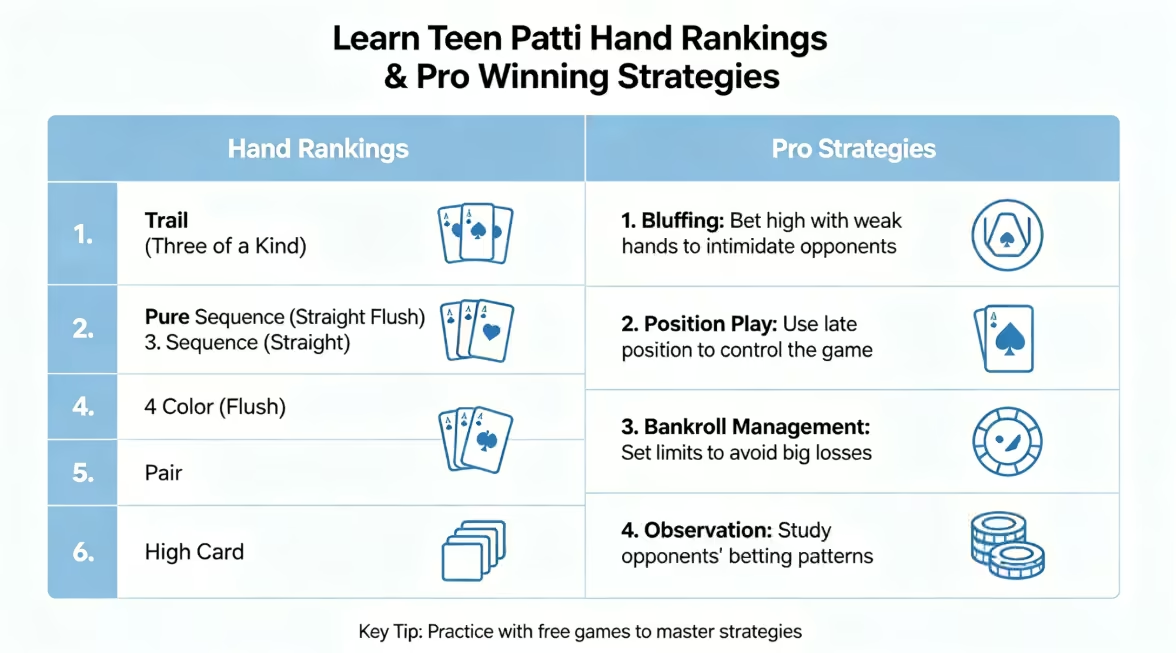
Below is the definitive hierarchical ranking of Teen Patti hands, structured from
the absolute strongest to the weakest.
[Highest Rank] Trio (Trail) ➔ Pure Sequence ➔ Sequence ➔
Color
(Flush) ➔ Pair ➔ High Card [Lowest Rank]
A Trio frequently referred to as a Trail or Set consists of three cards of the exact same rank or value, regardless of their suits. This is the ultimate powerhouse hand in Teen Patti.
A Pure Sequence occurs when you hold three consecutive cards that belong to the exact same suit. It combines the mathematical rarity of a consecutive run with the uniformity of a single suit.
A standard Sequence or Run consists of three consecutive cards, but unlike the pure sequence, they do not have to belong to the same suit.
A Color hand is formed when you hold any three cards that belong to the same suit, but they are not in a consecutive numerical sequence. When two players both hold a Color, the winner is determined by comparing the highest single card in their hands. If the highest cards tie, the second cards are compared, and so on.
A Pair is formed when you hold two cards of the identical rank, along with a third unmatched card (often called the “kicker”). If two players hold a pair, the player with the higher-ranking pair wins. If the pairs are identical, the value of the third card determines the victor.
If your three cards do not form a trio, a sequence, a flush, or a pair, your hand falls into the High Card category. Here, the hand has no internal synergy, and its strength relies entirely on the face value of its highest card.
Now that you understand the hand rankings, let’s look at how a live game of teen patti by octro indian poker card game plays out from start to finish.
Once the boot money is collected into the pot, the dealer distributes three cards, face down, to every participant in a clockwise direction. Crucially, players do not look at their cards immediately. They are left face down on the virtual table.
This is the feature that gives Teen Patti its unique tactical depth. On your turn, you must make a foundational decision: will you play as a Blind player or a Seen player?
The action begins with the player sitting to the immediate left of the dealer and moves clockwise around the table. When it is your turn, you have three primary operational choices:
To avoid draining your chip stack instantly in teen patti by octro indian poker card game, you must understand the mathematical relationship between Blind and Seen bets. The rules dictate strict scaling proportions based on the actions of the player who acted immediately before you.
| Previous Player Status | Current Player Status | Required Bet Amount |
|---|---|---|
| Blind | Blind | Equal to the current stake ($1\times$) or double ($2\times$) |
| Blind | Seen | Double the current stake ($2\times$) or quadruple ($4\times$) |
| Seen | Blind | Half of the current stake ($0.5\times$) or equal ($1\times$) |
| Seen | Seen | Equal to the current stake ($1\times$) or double ($2\times$) |
Pro Tip: If you are playing Blind and the player before you is Seen, your betting threshold remains highly economical. If you choose to flip your cards and become a Seen player mid-round, your structural betting requirements instantly double for the remainder of that hand.
As the betting rounds progress, the pressure mounts, and the pot grows exponentially. To resolve stalemates and eliminate opponents, Octro Teen Patti incorporates two vital mechanics: the Sideshow (Compromise) and the Showdown.
If there are three or more players active in the round, and you are a Seen player acting after another Seen player, you can request a Sideshow.
The game continues until almost everyone has folded. A final Showdown occurs when only two players remain on the table. One of the players pays the required fee to demand a “Show.”
Teen Patti is often mischaracterized as a game of pure luck. While the luck of the draw
determines your
initial cards, skill, psychology, and risk management determine whether you walk away
a
winner or a loser over hundreds of hands.
If you want to maximize your performance on platforms
highlighted by TeenPattiPro, integrate
these expert
strategies into your gameplay.
Many beginners make the mistake of looking at their cards the second they are dealt. Playing Blind is a psychological weapon. When you play Blind, your opponents know you aren’t scared because you don’t even know what you have. Furthermore, because your bets cost half as much as a Seen player’s, you can cheaply build the pot and pressure Seen players into folding mediocre hands. Try to play at least 2 to 3 rounds Blind if your chip stack allows it.
In teen patti by octro indian poker card game, a weak hand does not automatically mean a loss. If you bet confidently, raise the stakes without hesitation, and maintain a steady rhythm, players with superior cards like Pairs or low Sequences might panic and fold, assuming you hold a Trio. However, do not bluff predictability; mix up your playstyle so opponents cannot read your patterns.
Your physical positioning relative to the dealer matters immensely. If you are acting last, you have the profound advantage of watching how every other player bets. Are they hesitating before checking? Are they raising instantly? Octro’s digital platform allows you to observe how long an opponent takes to make a decision. A sudden delay often indicates uncertainty or a weak hand trying to calculate risk.
Emotional control (avoiding “tilt”) is what separates amateur players from professionals. If you receive a string of terrible High Card hands, do not emotionally commit chips out of frustration. Fold early, preserve your bankroll, and wait for a mathematically viable opening. Conversely, if you secure a premier hand like a high Pure Sequence, do not raise so aggressively that you scare everyone off immediately. Build the pot gradually to extract maximum value.
One of the reasons why players continuously flock to teen patti by octro indian poker card game is its diverse selection of game modes. Once you master the classic tutorial rules detailed above, you can test your skills in these exciting variations available on mobile:
Mastering the teen patti by octro indian poker card game requires a
delicate balance
of mathematical understanding, tactical patience, and psychological boldness. By internalizing the
hand
hierarchies memorizing that a Pure Sequence crushes a standard Flush, and learning how to manipulate
the
Blind-to-Seen betting ratios you give yourself a substantial competitive edge.
The digital world of
Indian poker is fast, dynamic, and deeply rewarding for analytical players. For more insights,
updates,
and direct access to premium game downloads, make sure to visit TeenPattiPro, your ultimate hub for everything related to
the
evolution of mobile card gaming.
Step up to the digital table, manage your bankroll responsibly,
read
your opponents’ tells, and may the best hand win!