


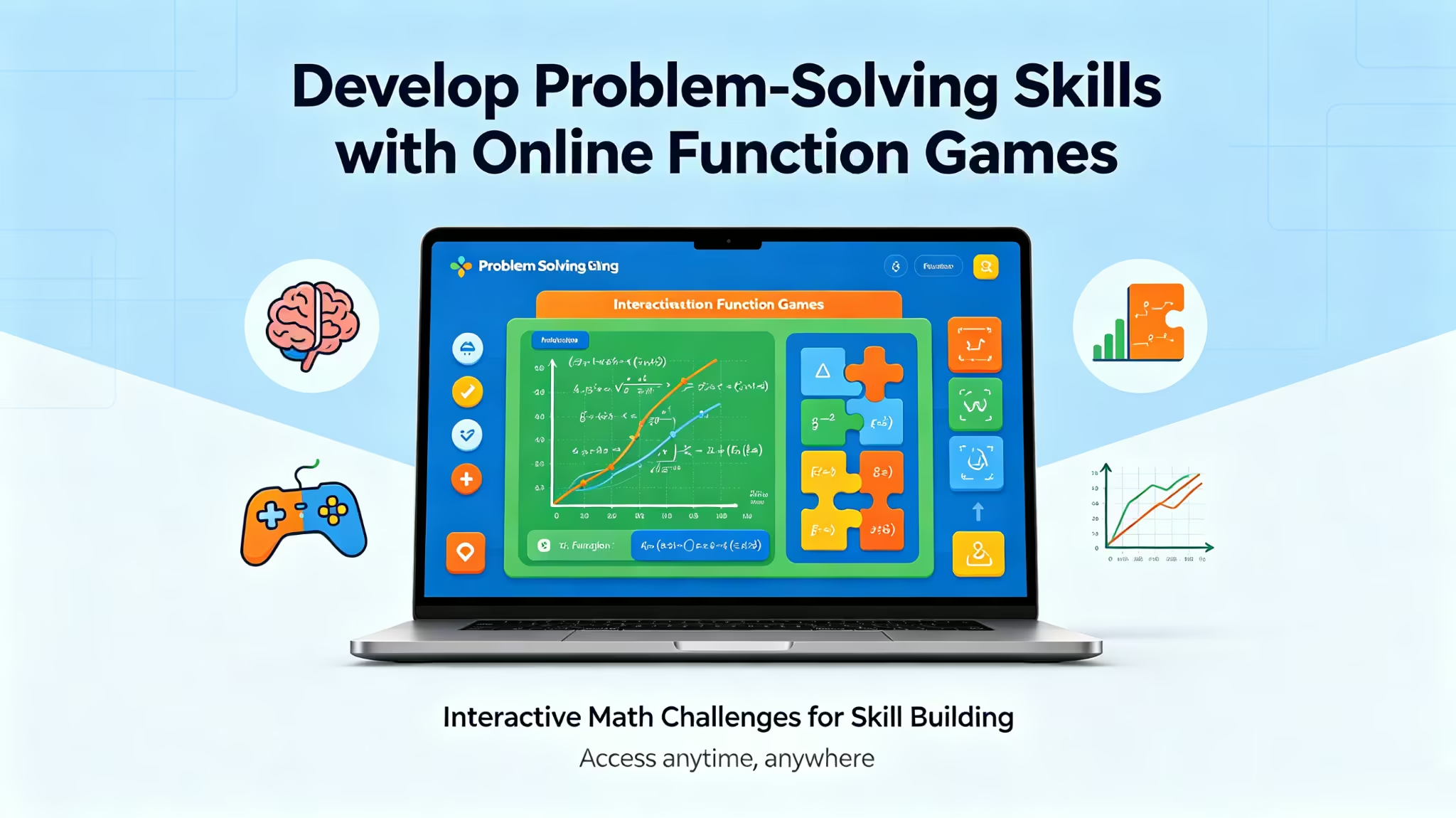
The landscape of mathematics education has dramatically shifted over the past decade. Gone are the days when students were strictly confined to repetitive worksheets to understand how numbers relate to one another. Today, the digital world offers a dynamic, engaging, and highly visual approach to learning complex concepts. Among the most effective tools in this modern educational arsenal are input output games online.
By transforming abstract mathematical rules into interactive challenges, these digital platforms allow students to grasp the foundations of algebra, computational logic, and problem-solving in a way that feels like pure entertainment. Whether you are an educator looking to liven up your lesson plans, or a parent wanting to support your child’s cognitive development at home, understanding how to leverage input output games is a game-changer.
This comprehensive guide will explore the mechanics behind these educational tools, the different types of games available, and actionable strategies for integrating them into a student’s learning journey.
Before diving into the games themselves, it is crucial to understand the foundational mathematics that power them. At the heart of these interactive experiences is the concept of functions and rules.
If you have ever asked, what is a function table in math, you are looking at the earliest building block of algebraic thinking. A function table is a simple chart that displays a relationship between a set of inputs and a set of outputs. For every number that goes into the “input” column, a specific mathematical rule (such as “multiply by 3” or “add 7”) is applied to generate the number in the “output” column.
In the digital realm, this concept is often brought to life through educational black box games for students. In these games, a virtual machine the “black box” hides the mathematical rule. The student drops a number into the machine, observes what comes out, and must use critical thinking to deduce the hidden operation happening inside.
Why should educators and parents prioritize these digital tools? The benefits extend far beyond simply memorizing arithmetic facts.
The internet is filled with diverse resources tailored to different age groups and skill levels. Understanding the categories of input output games online will help you choose the right tools for your learners.
These are arguably the most popular format for younger students. Featuring colorful graphics, animated gears, and fun sound effects, interactive number machine logic puzzles disguise math as a mechanical engineering game. A child might drag a block labeled “4” into a robot’s mouth, only to watch the robot spit out an “8.” The child must then figure out if the robot is adding 4 or multiplying by 2 by testing another number. This trial-and-error process is vital for deep comprehension.
For students who are ready to transition from highly animated visuals to more structured math formats, input output tables online games are the perfect stepping stone. These games present partially filled tables. Students must analyze the completed rows to find the pattern, and then apply that pattern to fill in the missing inputs or outputs. It is a highly effective way to practice mental math while solidifying the concept of functions.
Recognizing patterns is a foundational skill in both mathematics and science. High-quality mathematical pattern recognition software challenges students to look beyond simple addition or subtraction. They might encounter growing geometric patterns, Fibonacci-style sequences, or compound rules (e.g., “multiply by 2, then subtract 1”). By utilizing these platforms, students are actively improving sequence problem solving skills and mastering number patterns with interactive tools that track their progress and adapt to their skill level.
As students grow older, the basic arithmetic function machines can evolve into computer science concepts. Utilizing visual logic gate simulators for beginners introduces students to Boolean logic (AND, OR, NOT gates). Just like a math function machine, a logic gate takes an input (true/false or 1/0), applies a rule, and generates an output.
It is helpful here to understand the difference between a logic puzzle vs math function games. While math function games focus strictly on numerical operations (addition, division), logic puzzles and gate simulators focus on conditional rules and truth values. Both are incredible tools for developing a sharp, analytical mind.
Having access to great input output games is only half the battle; knowing how to facilitate the learning process is where true educational magic happens. If you are wondering how to teach function machines to kids effectively, follow these proven pedagogical strategies.
Before putting a child in front of a screen, introduce the concept physically. You can act as the “human function machine.” Have the child say a number (the input). You apply a secret rule in your head (e.g., add 3) and say the output. Let them guess the rule. This makes the transition to digital games completely seamless.
The core objective of these games is deduction. Teach children a systematic approach to identifying hidden mathematical rules:
When introducing a new online game, do not just hand over the device. Guide the student through the first few problems. Here is an effective step-by-step function machine walkthrough you can use:
For educators, incorporating input output games online requires resources that can be adapted to various classroom needs, from whole-group instruction to independent center work.
Teachers can utilize a math rule generator for classroom activities to keep lessons fresh. These digital generators can instantly produce hundreds of unique input/output tables, ensuring that students cannot simply memorize answers. You can display a generated table on an interactive whiteboard for a collaborative morning warmup, or print them out for offline practice alongside digital game time.
School budgets are often tight, which makes finding high-quality, free platforms a priority. Fortunately, the internet is rich with the best free computational thinking resources. Educational portals developed by universities, non-profit coding organizations, and open-source math communities offer incredible, ad-free games.
When searching for these tools, look for platforms that offer:
While elementary students benefit massively from simple addition and subtraction machines, middle school students can use the exact same input/output framework to explore pre-algebra and geometry.
For instance, input/output tables are the direct precursor to graphing linear equations on a coordinate plane. By teaching a student that the “Input” is the X-axis and the “Output” is the Y-axis, you instantly bridge the gap between basic arithmetic and advanced graphing. The digital games provide the scaffolding needed so that when students encounter formulas like $y \= 2x + 1$, they recognize it not as a confusing string of letters and numbers, but as a familiar function machine rule.
The beauty of modern math education is that we no longer have to rely on rote memorization to instill foundational concepts. By integrating input output games online into daily learning routines, we give children the opportunity to interact with math as a dynamic, solvable puzzle.
From colorful interactive platforms that capture the imagination of a first-grader to complex gate simulators that challenge middle schoolers, these tools are invaluable. They successfully bridge the gap between basic numeracy and advanced algorithmic logic, all while building algebraic thinking skills through play.
Whether you are utilizing a math rule generator for classroom activities, or simply sitting down with your child to play a few interactive number machine logic puzzles, you are doing much more than teaching math. You are fostering a mindset of curiosity, resilience, and logical deduction. So, boot up your browser, find a reliable educational game, and let the problem-solving begin!