


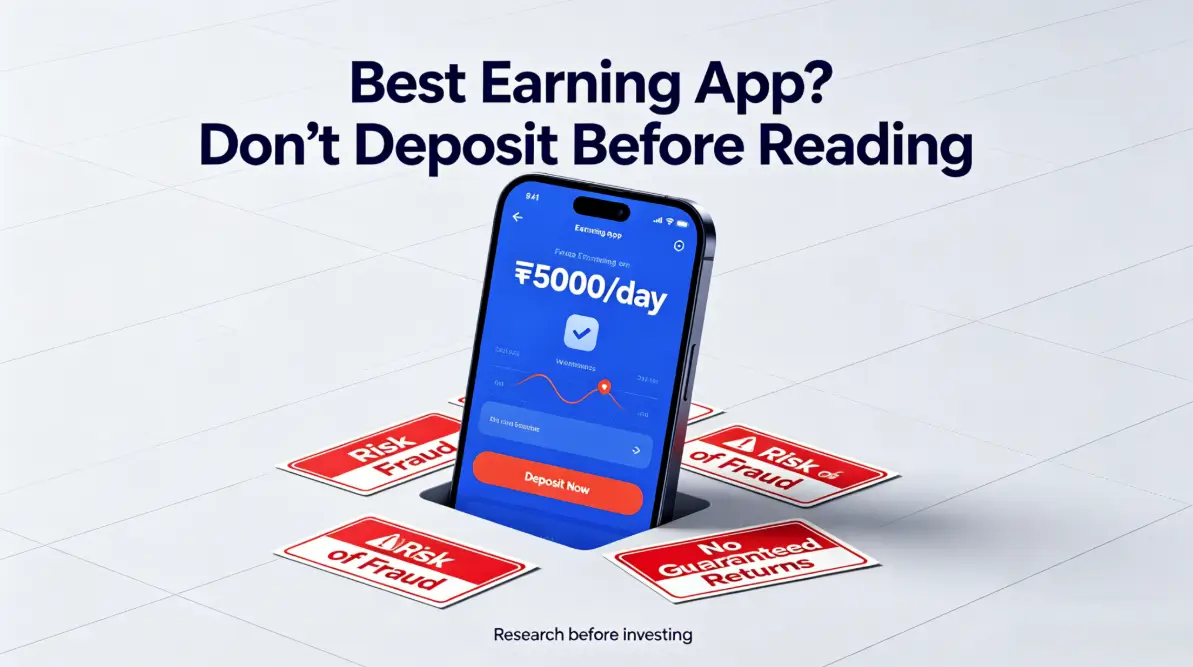
Type “best gaming earning app without investment” into Google, and you’ll be buried. Hundreds of results, thousands of articles, millions of promises. ₹9,000 a month. ₹1,500 a week. “Just play Teen Patti and earn.” No deposit needed. No risk involved. Just download, sign up, and the money starts flowing.
It sounds like a dream, and that’s exactly the point.
Let me tell you about a site called teenpattipro.com.in. Like many others in this space, it positions itself as the gateway to exactly this dream: a premium Teen Patti experience where you can “win real cash rewards” while playing a game you already know and love. The language is warm, the graphics are polished, and the button says “Download Now” not “Deposit Now.” It feels safe. It feels free.
But here’s the question nobody asks when they’re caught up in that “no investment” fantasy: if the app lets you earn without spending a rupee, who’s paying you? And why would they?
The answer, once you dig, is not comfortable. This article is that dig. I’ve spent days combing through user complaints, police reports, regulatory filings, and the fine print most people never read. What I found is a system designed to extract something far more valuable than your money. It extracts your trust. And then, eventually, it extracts your money anyway.
Before we dive into any specific platform, we need to define terms, because the language in this space is deliberately slippery.
An “earning” app implies that you are generating income through some productive activity. In legitimate contexts, earning means you are providing value your labor, your skills, your time and being compensated for it. But in the world of “earning” game apps, the word has been hollowed out and refilled with marketing. What you’re actually doing is gambling, and the “earnings” are winnings from bets placed against other players, or more often, against the platform itself.
The “without investment” part is even more misleading. It should signal a risk-free way to generate income. In practice, it usually means one of the following scenarios:
The phrase “best gaming earning app without investment” is, for all practical purposes, a search keyword designed to capture people looking for free money. And that vulnerability the hope for something for nothing is exactly what the operators behind these apps are counting on.
teenpattipro.com.in serves primarily as a portal to download Teen Patti Pro, a card gaming application that promises “the ultimate destination for all Teen Patti enthusiasts”. The platform advertises multiple game modes (Classic, Joker, Muflis, AK47), global real-time multiplayer, multi-language support, and the hook that matters: real cash rewards.
The marketing suggests a frictionless experience: download the APK, play the game you love, and earn real money. The implication one that countless “best gaming earning app” listicles enthusiastically reinforce is that you can start with nothing and build from there.
But what do actual users report? Let’s look at the evidence.
Across multiple complaint platforms, user forums, and review sites, a disturbingly consistent pattern emerges about Teen Patti Pro and its affiliated platforms. The deposit process is smooth almost too smooth. UPI, Paytm, bank transfer your money moves in seconds. The game plays well. You might even win initially. But the moment you try to pull winnings out, the machinery breaks down in predictable ways.
Here are real user reports, drawn directly from complaint databases:
The signing bonus turns into a trap. “On 5th april 2024 early evening 7:00 pm I started playing in this app with the bonus 100 rupees which I have received and earned around 500 and all of a sudden I started paying little high stake game and noticed little bit fraud kind bit as I have got good cards.” The bonus gets you in the door. The game makes you feel confident. Then the cards turn, the losses mount, and suddenly you’re not playing with “free” money anymore you’re reaching for your wallet.
The withdrawal button vanishes. “Teen patti has made our recharged but at the time of withdrawal they have removed the option of withdrawal they are asking more recharge to withdraw money while I have won 9000 rs but this amount is useless because I can’t withdrawal.” This user had ₹9,000 in winnings. The platform responded not by processing the withdrawal, but by removing the withdrawal button entirely and demanding more deposits.
The endless “processing” limbo. One user reported: “But its still in process from last 15-20 days.. I raised a complaint in customer care..of teen patti master they replied that there is payment gateway problem during withdraw money,but when we add money in the same game there is no payment gateway problem.” The logic here is damning: payment gateway works perfectly for deposits, mysteriously breaks for withdrawals.
The two-month wait for ₹1,000. “Teen patti dhan is totally fraud it can deposit money so easily but when you try to withdraw it’s takes 24 hrs of processing after that still not given to your bank account I am waiting for 2 months my 500 500 two withdrawal not received.” Two ₹500 withdrawals. Two months. Zero money received.
The account blackout. “It’s a big freaking fraud!! It asked for my account infos after I reach the amount when I can withdraw but now I can’t even check my bank account balance nor the pin work. I had 1.6k in my account but it’s totally black now.” This Trustpilot reviewer claims that after reaching the withdrawal threshold and providing account information, access to their entire account was revoked.
TeenPatti platforms on Trustpilot carry a rating of 1.7 out of 5, classified as “Bad”. The reviews paint a consistent picture: “Teen patti is a fraud I got withdraw problem with in 24 hous I not get refund amount still now also I did not get withdrawal draw amount. Iam trying to contact customer care number but I can’t reach anyone to hear my feed back.” Another user writes: “This game is totally fraud.. pls never ever install this.. you can able to withdraw. They will force you to add deposit more money.” And a third: “Unable to withdraw my money. customer service is unavailable for most of the times. It takes almost an hour for your turn to come and when it comes the app resets.”
These are not isolated complaints from one angry user. They are patterns patterns that span years (2023 through 2026), platforms (Teen Patti Pro, Teen Patti Dhan, Teen Patti Master, Teen Patti Qaeda Master, Namaste Teen Patti, Turbo Teen Patti, Teen Patti Sweet, and many more), and complaint venues (Consumer Complaints Court, Trustpilot, Sikayetvar, Voxya).
You might wonder: how can so many “Teen Patti” apps behave identically without being shut down? The answer lies in understanding the real business model, which has nothing to do with providing a fair gaming experience.
You find the app through a “best gaming earning app without investment” search, a social media ad, or a WhatsApp forward. The download is free. Installation takes seconds. You open it and see a clean, professional interface with polished graphics. Credibility is built through surface-level quality.
Upon registration, you receive a welcome bonus typically ₹41 to ₹120. It appears in your wallet as real money. You start playing with this “free” capital. “On 5th april 2024 early evening 7:00 pm I started playing in this app with the bonus 100 rupees which I have received.” The bonus feels like a gift but it’s actually a psychological hook. You feel like you’re playing with the house’s money. You take risks you wouldn’t normally take.
Many, many users report winning initially. The deck seems favorable. The opponents seem beatable. Your ₹100 becomes ₹300, then ₹500. “I won 700 INR and went for an withdrawal amount, it was declined.” Think about what’s happening here: the platform lets you win enough to believe the system works, but not enough to actually cash out.
This is where the “no investment” promise collapses. When you attempt to withdraw, you discover the barriers. The minimum withdrawal might be ₹100, but only “earnings from gaming” count bonus money is locked. Your ₹500 balance might be 60% bonus funds, leaving only ₹200 theoretically withdrawable. You need more “earnings” to hit the minimum. So you keep playing.
As your balance grows and the withdrawal threshold gets closer, something subtle shifts. The cards turn. You lose a few hands you “should have” won. Your ₹300 drops to ₹150. Panic sets in not because you’ve lost money you deposited, but because you’ve lost money you were already mentally spending.
The app now suggests a small deposit to “top up” and keep playing. Just ₹100. Just to protect what you’ve already “earned.” Many users make this first deposit. The “no investment” app has just received its first investment. “I have won 9000 rs but this amount is useless because I can’t withdrawal” to unlock it, the platform demanded more deposits.
When you attempt a larger withdrawal, the platform activates KYC (Know Your Customer) verification. You’re asked to submit PAN card, Aadhaar card, and bank details. This is framed as a security requirement, and legitimate platforms do require KYC. But on these apps, KYC becomes another barrier: users report that their documents are “under review” indefinitely, or that verification repeatedly fails for unspecified reasons. Meanwhile, the platform now has your sensitive identity documents a concerning data privacy risk.
One complaint notes that KYC details were allegedly misused: “The FIRs also alleged that the complainants’ KYC details were misused by the company, leading to substantial financial losses due to fraudulent activities.”
Even after KYC, new demands appear. Users are told they need to reach a certain VIP level to withdraw. “I nearly deposited 68000 and while withdraw was made, they saying increase VIP level.” Another user reported: “Vagas teen patti King app download and money diposit first 100 विड्रॉल and close increase withdrawal 500 withdrawal and close increase VIP Laval not withdrawal me more diposit money scam.”
Wagering requirements are another classic weapon. The platform may require you to wager a multiple of your deposit before any withdrawal is possible often 10x, 20x, or more. You deposit ₹500, and suddenly you need to place ₹5,000 worth of bets before you can touch a rupee. By the time you’ve wagered that much, statistically, you’ve already lost.
Throughout this process, customer support is strategically unavailable. “customer service is unavailable for most of the times. It takes almost an hour for your turn to come and when it comes the app resets.” Response times stretch from hours to days to never. The platform is not interested in resolving your problem it’s interested in wearing you down until you give up.
Some platforms feature a “reverse withdrawal” button a prominently placed option that lets you cancel your withdrawal request and return the money to your gaming account with a single click. The psychology is transparent: while your money sits in “pending” limbo, you might get frustrated, cancel the withdrawal, gamble the balance away, and the platform wins without ever having to reject you.
One of the most popular features promoted under the “best gaming earning app without investment” banner is the refer-and-earn program. The pitch goes like this: you don’t need to invest your own money just invite your friends, and when they play, you earn a commission. “You’ll get forty one rupees, anytime an individual signs up utilizing your link, and you’ll carry on to receive thirty% commission on their own tax amounts for as long as you Are living.”
This sounds like passive income. It’s not. Here’s what actually happens:
First, the ₹41 signup bonus per referral is almost certainly locked behind the same withdrawal barriers as your gameplay earnings. You might see the balance grow, but getting it out is another story.
Second, the 30% commission on “tax amounts” means you only earn when your referred friends lose money. The platform takes a cut of their deposits. You get a cut of the platform’s cut. This incentivizes you to bring in people who will lose, because that’s the only way you see a return.
Third, when those friends inevitably encounter the withdrawal problems described above, they’ll come to you the person who recommended the app for answers. You’ve now damaged real relationships for the promise of commissions that you yourself probably can’t withdraw.
This structure is not an earning program. It is a viral recruitment engine that turns users into unpaid marketers, exploiting social trust for the platform’s benefit. You are not the entrepreneur. You are the product’s distribution channel.
If you’ve been reading this and thinking “surely this is illegal,” you’re right and as of 2026, the legal situation has become dramatically clearer.
In August 2025, the Indian Parliament passed the Promotion and Regulation of Online Gaming (PROG) Act, a landmark piece of legislation that fundamentally restructured India’s approach to online games. The Act divided games into three categories:
Under this framework, any Teen Patti platform that accepts deposits and offers cash payouts falls squarely into the third category. It doesn’t matter that Teen Patti involves elements of strategy. It doesn’t matter that the platform calls itself a “skill game.” If money goes in and the expectation of money coming out exists, it’s prohibited.
On April 22, 2026, the Ministry of Electronics and Information Technology (MeitY) notified the Promotion and Regulation of Online Gaming Rules, 2026, which operationalize the PROG Act starting May 1, 2026. These rules create the Online Gaming Authority of India (OGAI), a digital-first regulatory body with significant enforcement powers.
The OGAI has the authority to classify games, investigate complaints, and critically direct banks and payment systems to block transactions linked to prohibited online money games. IT Secretary S. Krishnan stated plainly: “The banks and the financial institutions, as you’re aware, under the Act, there are provisions which say that anybody who participates in promoting this activity or providing financial transactions for such activity will also be guilty of an offence under the original Act.”
What this means: if you deposit money into an unregistered money game after May 1, 2026, the bank processing your transaction could itself be violating the law. The payment infrastructure is being actively dismantled.
Penalties under the framework are severe. Individuals involved in operating, promoting, or advertising online money games can face imprisonment of up to 2-3 years and fines up to ₹5 lakh. Corporate entities face fines up to ₹1 crore. Celebrity endorsements are also prohibited meaning that influencer who promoted “the best Teen Patti earning app” may face legal consequences.
The “no investment” framing does not exempt a platform from being classified as an online money game. The OGAI classification criteria include factors such as: does the game involve stakes? Is there an expectation of monetary winnings? What is the revenue model? How are in-game assets redeemed?
If a platform offers “free” bonuses but ultimately funnels users toward deposits, displays “cash” prizes, and processes (or pretends to process) withdrawals, it meets the definition of an online money game. The “no investment” language is marketing, not a legal shield.
Behind every complaint is a real person who trusted a platform and got burned. Here are some of their voices:
A 36-year-old businessman from Hyderabad received WhatsApp messages in 2025 promoting online betting on Teen Patti, cricket, and casino games. The fraudsters promised “high and guaranteed profits.” To test the platform, he deposited ₹20,001 and received ₹5,000 as profit. This early win built trust. Between 2025 and January 2026, he deposited approximately ₹1.5 crore across multiple transactions. Although he initially received about ₹20 lakh back, the platform eventually blocked withdrawals and redirected him to interconnected betting sites that frequently changed domains and bank accounts. He lost everything.
Anil, a user who filed a complaint in December 2023, described his experience with a Teen Patti APK: “Sir my name is Anil and I was trapped in fraud apk named dhani teen Patti and scam of 13.6 lakh INR . This is totally fraud whenever I bet smaller umi won but when I bet 2000+ every time I loss my money…and I was addicted to recover the lost money…..I took all types of loan and Play this apk which is still available in play Store. When I loose My all money then I realised that I was trapped in this scam.”
Notice the pattern: small bets won, large bets lost. This is not random. It’s the algorithm at work, designed to extract maximum deposits before the user realizes what’s happening.
In March 2026, the Navi Mumbai Cyber Police arrested two men for duping a victim of over ₹65 lakh through a fake gaming platform called SAT Sports. The platform “projected itself as a legitimate listed gaming company” and displayed fake profits to build trust. The complainant was encouraged to invest in Teen Patti and casino games, with the portal showing manufactured winnings. Between January 2023 and February 2026, the victim lost ₹65.16 lakh. The case revealed links to Dubai-based operatives, suggesting an international fraud network.
On April 1, 2026, a user requested two withdrawals of ₹520 each from Teen Patti Qaeda Master. The money never arrived. On April 2, another user reported three withdrawals of ₹1,000 each, totaling ₹3,000, stuck for 8-9 days. These are not large sums they’re test withdrawals, the kind a cautious user makes to verify the platform is legitimate before investing more. When even ₹1,040 can’t be extracted, the platform is telegraphing its intentions.
One particularly insidious variant: the Teen Patti Lucky application, pre-installed on a Realme GT 6T phone. “This application is a fraud because it tricks user to credit real money and play. The game not looks fare. After winning I am not able to withdraw my money.” When the fraud is baked into the phone’s factory software, unsuspecting users start from a position of trust that is completely undeserved.
Let’s step back from the complaints and consider the pure economics. A gaming platform that genuinely allows users to earn money without investment would have to generate revenue from somewhere else to fund those payouts.
Advertising revenue? A free-to-play card game with a few thousand users generates minimal ad income typically fractions of a rupee per user per session. This cannot fund ₹500 payouts, let alone the ₹9,000 monthly earnings some platforms dangle as bait.
In-app purchases from other users? If a platform makes money from cosmetic purchases (skins, themes, etc.), it could theoretically share some revenue with players. But Teen Patti Pro-style apps don’t emphasize cosmetics they emphasize cash prizes. The numbers don’t add up. If 90% of users play entirely free, and 10% buy ₹50 worth of skins, the per-user revenue pool is perhaps ₹5. That doesn’t support ₹100+ signup bonuses.
The house edge? In a peer-to-peer card game where the platform doesn’t participate as a player, there is no house edge. The platform cannot earn from the games themselves unless it’s playing against users or manipulating the outcomes. And if it’s manipulating outcomes, it’s not a game; it’s a rigged system.
The uncomfortable truth is that any platform offering “earning without investment” at scale is either:
There is no fourth option where a benevolent company gives away free money for playing card games.
If you’re reading this and have been tempted by a “best gaming earning app without investment” ad, here is a checklist you can use right now:
The app says “earn.” But what does it actually mean by earn? Is there a transparent, fixed payment for specific actions (like “complete this survey, get ₹20”)? Or is the “earning” dependent on winning against other players? If it’s the latter, it’s gambling and it’s being misrepresented.
If the signup bonus is ₹100 and the withdrawal minimum is ₹500, you’re being set up. You’ll need to either win 5x your starting capital (improbable) or deposit your own money (inevitable).
Search the terms for phrases like “minimum wagering,” “turnover requirement,” “play-through,” or “VIP level.” If these exist and are substantial (more than 1x-3x), the game is designed to burn through your balance before you can withdraw.
If the platform distinguishes between “bonus balance” and “cash balance” and only the latter is withdrawable, understand that your visible balance is inflated and your real money is smaller than it appears.
Check Trustpilot, consumer complaints sites, Reddit, and app store reviews. Look specifically for withdrawal-related complaints. One or two negative reviews might be anomalies. Dozens of nearly identical complaints about withdrawal failures are a pattern. The Teen Patti ecosystem’s 1.7 Trustpilot rating and hundreds of unresolved complaints are a flashing red beacon.
Who runs the platform? Is there a registered company with a physical address? Can you find the names of the founders or management team? If the “About Us” section is vague or non-existent, the platform is designed to be untraceable and that’s by design.
Try this: before depositing a single rupee, attempt to contact customer support. Ask a specific question about withdrawal policies. If you can’t reach a human within a reasonable time, or if the response is evasive, consider what will happen when there’s real money on the line.
If the app pushes its referral program harder than the actual game, that’s a tell. A real gaming platform makes money from gameplay. A pyramid scheme makes money from recruitment. Which one are you looking at?
This article has been overwhelmingly negative so far, and for good reason: the “best gaming earning app without investment” space is overwhelmingly fraudulent. But that doesn’t mean there are no legitimate ways to earn from gaming. There are they just look nothing like the Teen Patti Pro model.
Under India’s 2026 regulatory framework, esports are explicitly recognized and promoted. Registered esports platforms with valid OGAI certifications (valid for up to 10 years) can offer prize pools for competitive tournaments. If you’re genuinely skilled at games like Valorant, BGMI, Chess, or FIFA, you can compete for real prizes on regulated platforms. This requires actual skill, practice, and often team coordination it is not “passive earning” and it is not “without effort.” But it’s legitimate.
Streaming your gameplay on YouTube or Twitch, creating gaming tutorials, or building a gaming-focused social media following can generate ad revenue, sponsorships, and viewer donations. This takes months or years to build, requires content skills beyond gaming ability, and is highly competitive. But many people do earn real income this way.
The 2026 Rules explicitly permit online social games games played purely for entertainment, with no real-money wagering. Many Teen Patti apps operate under this model. They’re upfront about it: “This game is intended for an adult audience and does not offer real money gambling or an opportunity to win real money or prizes.” You play for points, for rank, for the joy of the game. You lose nothing but time, and you gain nothing but entertainment. There is a certain honesty in that, and it’s worth appreciating.
Some legitimate platforms pay users to test games and provide feedback. Companies like PlaytestCloud and UserTesting occasionally have gaming-related projects. The pay is modest, the work is sporadic, and it’s not “playing games for fun” it’s providing structured feedback. But if someone offers you money to test a game, that’s a known, legitimate model.
Teen Patti is a genuinely wonderful game. It has survived for generations not because of money, but because it creates moments: the tension of a blind bet, the thrill of a well-timed bluff, the laughter when someone’s “sure thing” gets crushed. These are the experiences that matter.
Play the free, social versions. The Apple App Store Teen Patti Pro listing states clearly: “This game is intended for an adult audience and does not offer real money gambling or an opportunity to win real money or prizes.” That’s the version you want. No withdrawal anxiety. No deposit pressure. Just the game.
Play with friends in private rooms. Many legitimate social Teen Patti apps offer private room features where you can invite specific people. This recreates the original social context that made the game great.
Set a hard rule: never deposit. If you’re on any Teen Patti platform, make a pact with yourself that you will never add money. Use only what the platform gives you. The moment the game pushes you toward a deposit, close it.
Report scam platforms. If you encounter a platform that fits the patterns described in this article, file a complaint with the National Consumer Helpline (1800-11-4000), the National Cyber Crime Reporting Portal (cybercrime.gov.in), or the OGAI after May 1, 2026. Every complaint creates a paper trail and makes it harder for scam operators to persist.
A: In practice, no. Platforms that promise this almost always fall into one of three categories: they require you to eventually deposit to reach withdrawal thresholds, they display “earnings” that cannot actually be withdrawn, or they are outright scams. The mathematics simply does not support a business giving away money for free gameplay. If you encounter such a claim, approach it with extreme skepticism.
A: According to available platform documentation, Teen Patti Pro’s minimum withdrawal is ₹100, and “withdrawals are only allowed for the money earned from gaming, and not the bonus amount collected.” This means your signup bonus is essentially locked you can use it to play, but you cannot cash it out directly. You must first “earn” (win) enough above the bonus to hit the ₹100 threshold, using only the bonus as your starting capital. The probability of doing this without eventually depositing your own money is extremely low.
A: Apply the red flag checklist from Part 8 of this article. Specifically: (1) Are withdrawals transparent and well-documented? (2) Are user reviews broadly positive, particularly about withdrawals? (3) Is the platform operator identifiable and traceable? (4) Does the business model make sense where does the payout money actually come from? (5) Is the platform registered with OGAI (after May 1, 2026)? If you cannot confidently answer “yes” to these questions, do not engage.
A: The bonus trap works like this: the platform gives you ₹41-₹120 as a welcome bonus. You play, you win, and your balance grows to perhaps ₹500. At this point, you attempt to withdraw. You discover that only a portion of that ₹500 is withdrawable (bonus funds are locked), that you may need to meet wagering requirements (e.g., bet 10x the bonus amount), or that you need to reach a higher VIP level to activate withdrawals. To meet these requirements, you need to keep playing and to keep playing with enough capital to have a chance, you may feel pressured to deposit. The “free” bonus was never free. It was bait.
A: Some are, but many in the Teen Patti ecosystem are structured problematically. If the commission depends on your referrals losing money (e.g., 30% of their “tax” or platform losses), you’re being incentivized to bring people into a system where they’ll be financially harmed. If the referral earnings themselves are locked behind the same withdrawal barriers as gameplay winnings, you may never receive them. Additionally, if the underlying platform is an illegal online money game, participating in its referral program could potentially expose you to legal risk as a promoter.
A: Under the PROG Act 2025 and the 2026 Rules effective May 1, any platform that involves users depositing money and playing with the expectation of winning money regardless of skill versus chance is classified as a prohibited online money game. This makes operating, promoting, and facilitating such platforms illegal. While individual player enforcement is less likely than platform-level enforcement, participating in prohibited gambling activities carries risk, and your ability to recover funds through legal channels will be extremely limited.
A: Take these steps immediately: (1) Document everything screenshots of your balance, withdrawal requests, error messages, and all correspondence with support. (2) File a complaint with the National Consumer Helpline. (3) Report the platform through the National Cyber Crime Reporting Portal. (4) After May 1, 2026, file a complaint with the Online Gaming Authority of India (OGAI). (5) Contact your bank and explain the situation they may be able to dispute certain transactions. Be realistic about recovery: funds deposited into prohibited or fraudulent platforms are notoriously difficult to reclaim.
A: This is a deliberate strategy called “brand sprawl.” Operators release multiple apps under slightly different names (Teen Patti Pro, Teen Patti Dhan, Teen Patti Master, Teen Patti Qaeda Master, Teen Patti Sweet, Namaste Teen Patti, Turbo Teen Patti, Teen Patti Gold, Teen Patti Club, etc.) to maximize search visibility, escape negative reviews that accumulate under any single brand, and evade regulatory attention. When one app is flagged or shut down, the operator simply pivots to another. The similarity you’ve noticed is not coincidence it’s business strategy, and it’s a red flag.
A: Yes the ones that explicitly state they are for entertainment only and do not involve real money. The Teen Patti Pro listing on the Apple App Store, for example, states: “This game is intended for an adult audience and does not offer real money gambling or an opportunity to win real money or prizes.” These apps are designed for social play and are classified as online social games under the 2026 framework. You can play them freely without worrying about withdrawal problems, because there’s nothing to withdraw.
A: If someone has found a way to generate free money from a game, they will not share it with strangers on the internet. They will scale it quietly, extract every rupee, and retire. The very fact that an app is advertising its “earning” potential to you, a stranger, means you are not the earner you are the product. Whether the platform is harvesting your data, your deposits, or your social network, you are the source of value, not the recipient. Internalize this, and the “no investment” fantasy dissolves on contact.
The search for a “best gaming earning app without investment” is understandable. Times are hard. Incomes are stretched. The idea that your phone the device you already own, the games you already play could generate a little extra income is genuinely appealing. It speaks to a desire for agency, for a side path to financial breathing room.
But the people who build these platforms know that desire intimately. They have studied it, monetized it, and weaponized it. They wrap themselves in the language of opportunity while operating systems designed to extract. And they count on the fact that by the time you understand what’s happening, you’ll be too embarrassed to speak up, too small to sue, and too exhausted to fight.
You’re worth more than that. Your time is worth more than a fake ₹500 balance. Your trust is worth more than a “welcome bonus” that can never be withdrawn. And the next time you see “Teen Patti Pro earn real cash without investment,” you’ll know exactly what you’re looking at: not an opportunity, but a trap with a very familiar shape.
Play the game. Enjoy the cards. Laugh with your friends. But leave the “earning” promises where they belong in the marketing copy you’ve learned to see right through.